Projects

NIPU-EJD (website)

Stellar (website)

BIODEST (website)

SUSPOL

PROSTEM 3

HYB2HYB

BATWAL

CALFDM

NANOSOL

BIORGEL

SOLIDYE

BIOMAT

MACOBIO

HYBRITIMESURF

PHOTONITEX (website)

3D4MED (website)

BIOHARV (description)

ALPO (website)

TEXTOS (website)

BIOCOMPAL (website)

ELASTOPLAST (website)

THERMOHARV (website)

Repenser le plastique au cœur de la rénovation durable

The UP_PLASTICS portfolio aims to develop a complete value chain around the design of new functional and circular plastics for construction and building, integrating the multiple needs and demands of the sector. This includes both the design of new low-carbon footprint products and the recycling of waste generated by the renovation of existing buildings.

The 9 projects in the portfolio focus on two main applications: (1) coatings and paints, and (2) foams for thermal insulation, acoustic insulation, and electromagnetic shielding. These projects integrate the eco-design of circular plastic materials through the transformation and valorization of two types of inputs: (i) renewable resources (biomass, including insect-derived raw materials and CO2), and (ii) waste from the construction sector (wood, PVC, etc.).

The portfolio is associated with a unique value chain designed to ensure easy transfer to Walloon industries, while targeting implementation processes compatible with existing industrial infrastructures and equipment.

General Description of the WAL’PROT Project

The global demand for plant-based proteins is currently estimated at 170 million tons per year. This figure is expected to increase in the coming years due to the needs of both animal feed and human nutrition, driven by global population growth and the development of new dietary patterns that move away from animal proteins (vegan, vegetarian, flexitarian, etc.).

At present, Europe faces a deficit in protein crops. In 2016, more than 18 million tons of proteins, mainly soy, were imported, representing around 50% of the demand. In the future, supply tensions are expected on the global market, particularly due to the growing needs of Asian countries or as a result of geopolitical conflicts, such as those observed following the war in Ukraine, which has had repercussions for food supply in Europe.

At the same time, consumers are increasingly demanding natural products, organic farming, and locally sourced foods. However, the area dedicated to protein crops remains relatively limited in Wallonia, although it is growing as in the rest of Europe. One explanation is that these crops often generate lower income for farmers, mainly due to yield variability and harvest quality issues.

In parallel, significant amounts of plant-based biomass naturally containing proteins are downgraded or left unused each year because of their rapid degradation. Stabilizing these materials is therefore a major challenge in order to preserve their quality and enable their valorization. In addition, the agri-food industry produces numerous protein-rich co-products that could also be better utilized.

The WAL’PROT project portfolio aims to develop new pathways for the valorization of plant-based and alternative proteins for the human food sector. The objective is to provide advanced solutions to valorize new protein sources, not only from dedicated crops but also from discarded plant materials, agri-food industry co-products, microalgae, and insects.

WAL’PROT also proposes to integrate a cascade valorization model for all by-products generated during protein processing, through a multisectoral approach.

Role of UMONS in WAL’PROT

Two departments of UMONS contribute to the WAL’PROT 8 project, intervening at different stages of the project. The Proteomics and Microbiology Service (PROTMIC – Prof. R. Wattiez) aims to develop, produce, and characterize alternative proteins derived from microalgae. The Polymer and Composite Materials Service (SMPC – Prof. Jean-Marie Raquez) is involved in the valorization of co-products resulting from protein extraction—both protein and non-protein fractions—through the development and characterization of environmentally friendly materials.

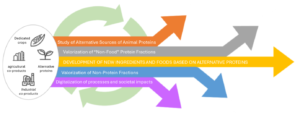
The project is structured around four main axes:

  • Axis 1: Develop and produce alternative proteins from microalgae.
  • Axis 2: Valorize protein-based co-products from the extraction of high-quality proteins through the development of environmentally friendly materials.
  • Axis 3: Valorize non-protein co-products from protein extraction through the development of environmentally friendly materials.
  • Axis 4: Characterize all raw materials, as well as protein and non-protein derivatives.

Revitalization of Moroccan Aquaculture through the Valorization of Natural Resources from Arthropods

Despite Morocco’s unique potential with its 3500 km of coastline and political support, its aquaculture sector struggles to reach its economic potential. Our project offers a new development pathway for the sector while preserving Moroccan marine wildlife and establishing an agro-industry based on black soldier fly (BSF) or shrimp farming. The academic, institutional, and industrial consortium will use BSF proteins for aquaculture fish feed and explore the valorization of BSF or shrimp by-products for chitin extraction. This chitin will be used to develop new, environmentally friendly materials, such as fishing nets. Additionally, the project will assess the ecological impact of these materials on Moroccan marine life.

Revitalization of Moroccan Aquaculture through the Valorization of Natural Resources from Arthropods

Despite Morocco’s unique potential with its 3500 km of coastline and political support, its aquaculture sector struggles to reach its economic potential. Our project offers a new development pathway for the sector while preserving Moroccan marine wildlife and establishing an agro-industry based on black soldier fly (BSF) or shrimp farming. The academic, institutional, and industrial consortium will use BSF proteins for aquaculture fish feed and explore the valorization of BSF or shrimp by-products for chitin extraction. This chitin will be used to develop new, environmentally friendly materials, such as fishing nets. Additionally, the project will assess the ecological impact of these materials on Moroccan marine life.